
Delhi surprises you. For most Americans, this city conjures images of the Red Fort, chaotic bazaars, and spicy street food. But walk a few blocks in any direction and you will find yourself standing outside one of Delhi’s many Gurudwaras, where the sound of kirtan drifts through open doors and the smell of langar cooking fills the street. These Sikh temples are among the most welcoming spiritual spaces in the world, open to visitors of every faith, background, and belief.
Whether you are a Sikh traveler tracing your heritage or a first-time visitor curious about India’s religious history, Delhi’s famous Gurudwaras offer something rare: genuine warmth, centuries of stories, and a free meal that will reshape your understanding of community.
Gurudwara Bangla Sahib is the most famous Gurudwara in Delhi, and it makes for a strong starting point. But the city has nine others that are just as worth your time. Here is your complete guide to 10 famous and historical Gurudwaras in Delhi that every traveler should know about.
Table of Contents
List of Historical Gurudwaras in Delhi to Visit
| Gurudwaras | Location |
| Gurudwara Bangla Sahib | Ashoka Road |
| Gurudwara Sis Ganj Sahib | Chandni Chowk |
| Gurudwara Baba Banda Singh Bahadur | Mehrauli Village |
| Gurudwara Mata Sundri | Mandi House |
| Gurudwara Bala Sahib | Hari Nagar Ashram |
| Gurudwara Moti Bagh Sahib | Moti Bagh |
| Gurudwara Damdama Sahib | Nizamuddin East |
| Gurudwara Rakab Ganj | Pandit Pant Marg |
| Gurudwara Majnu Ka Tilla | Chandni Chowk |
| Gurudwara Nanak Piao Sahib | Rana Pratap Bagh |
1. Gurudwara Bangla Sahib – The Most Visited Famous Gurudwara in Delhi
- Location: Ashoka Road, near Connaught Place
- Best Time to Visit: October to March
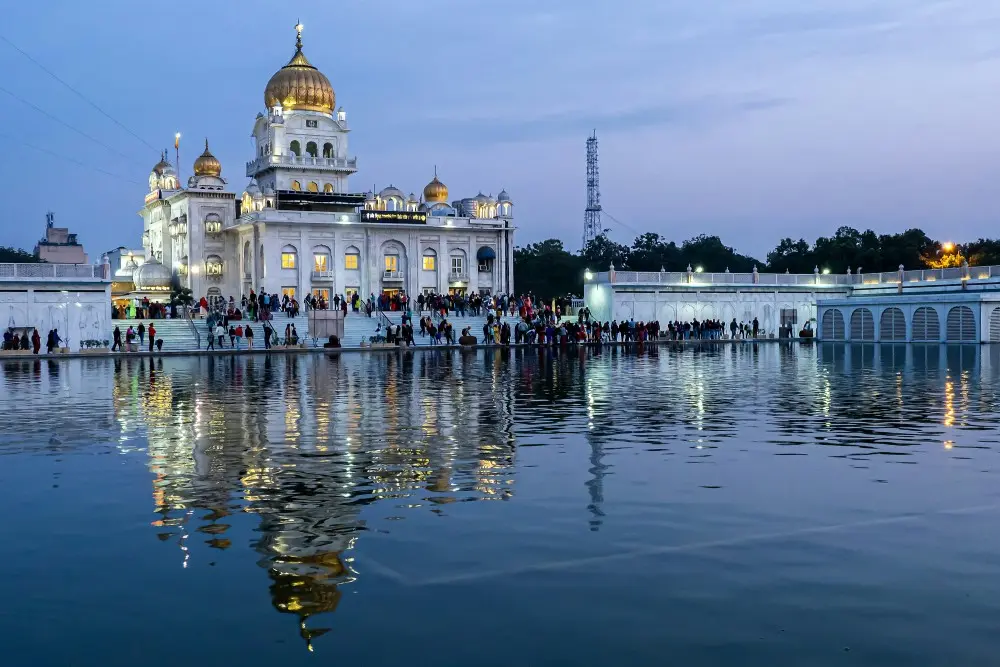
If you visit only one Gurudwara in Delhi, make it Bangla Sahib. Sitting just off Connaught Place, this is the most visited famous Gurudwara in Delhi and one of the most recognizable Sikh landmarks in all of India. Its golden dome catches the sunlight and is visible from several blocks away.
The site has deep roots. Before becoming a Gurudwara, this was the bungalow of Raja Jai Singh of Amber. In the 17th century, the eighth Sikh Guru, Guru Har Krishan, stayed here and tended to thousands of locals suffering from smallpox and cholera. He used water from the well on the property to provide relief to the sick, and that well, now called the sarovar, is considered holy to this day.
Visitors can walk around the sacred pool, which is lined with white marble and filled with calm, still water. Many Sikhs take a dip or splash water on their faces as an act of prayer. Even if you simply walk around it quietly, the atmosphere is something you will carry with you long after you leave Delhi.
The langar here runs 24 hours a day, 7 days a week. Thousands of people eat here daily, no questions asked. Sit cross-legged on the floor, accept a steel tray, and share a meal with strangers who become, for a few minutes, something closer to family.
Bangla Sahib is open around the clock and easy to reach by metro. The Shivaji Stadium station on the Blue Line drops you right at its doorstep.
2. Gurudwara Sis Ganj Sahib – Delhi’s Famous Gurudwara in Chandni Chowk
- Location: Chandni Chowk, Old Delhi
- Best Time to Visit: November to February
Of all the historical Gurudwaras in Delhi, Sis Ganj Sahib carries perhaps the heaviest weight of history. This is a martyrdom site. It marks the place where Guru Tegh Bahadur, the ninth Sikh Guru, was publicly executed in 1675 on the orders of Mughal Emperor Aurangzeb, after he refused to convert to Islam.
He didn’t die protecting his own faith alone. He died defending the right of Kashmiri Pandits, a Hindu community, to practice their religion freely. That act is central to how Sikhs understand their faith, and walking into Sis Ganj Sahib, you feel the gravity of it in a way that no history book quite prepares you for.
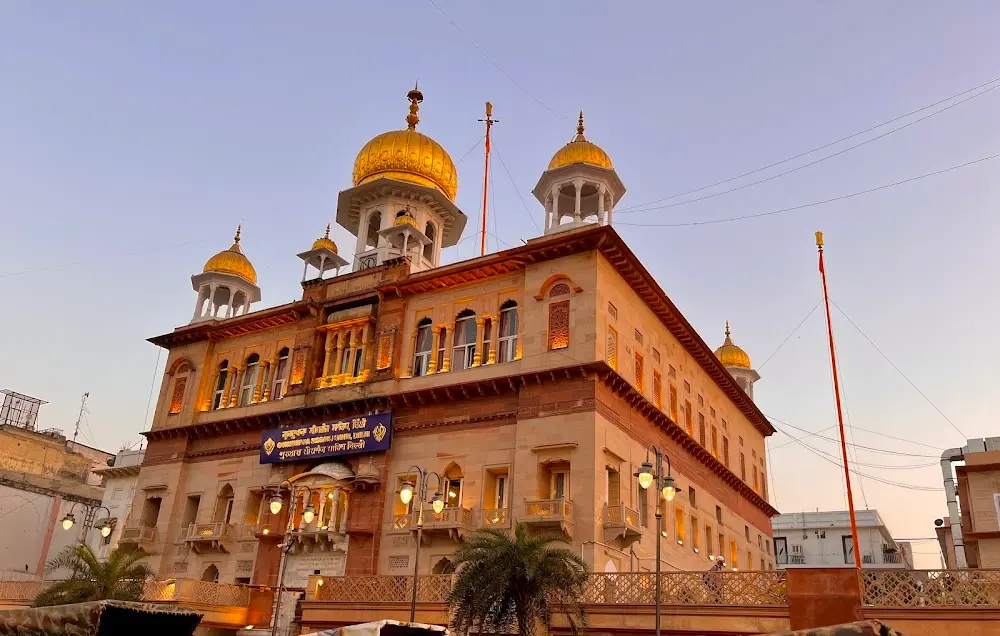
The Gurudwara was originally constructed by Sardar Baghel Singh in 1783, making it one of the oldest Gurudwaras in Delhi. The structure was completed in 1930 and features a striking two-story prayer hall, sandstone parapets, mesh-work windows, and seven gold-topped kiosks on the roof.
Located in the heart of Chandni Chowk, this is also the most accessible Gurudwara for travelers exploring Old Delhi. Pair it with a morning walk through the spice market at Khari Baoli, just a short walk away. Parking here is nearly impossible, so take the metro to Chandni Chowk station and cover the last five minutes on foot.
3. Gurudwara Baba Banda Singh Bahadur – A Historical Sikh Shrine in Mehrauli
- Location: Mehrauli Village, South Delhi
- Best Time to Visit: October to April
Most tourists who reach Mehrauli go straight to the Qutub Minar and head back. A smaller group knows to look for this Gurudwara, tucked into the village lanes nearby, and that group leaves with a much deeper experience of what the neighborhood holds.
Gurudwara Baba Banda Singh Bahadur marks the site where Banda Singh Bahadur, one of the most revered warrior-saints in Sikh history, was tortured and executed by the Mughals in 1716. He was captured along with his young son and roughly 700 other Sikhs. Their courage in the face of that fate became a defining chapter in Sikh memory and a story that Sikhs around the world still draw strength from today.
The Gurudwara is built in white marble. The main prayer hall, called Darbar Sahib, is where devotees recite the Guru Granth Sahib throughout the day. One of the more interesting features of the compound is the Baoli Sahib, a historic stepwell that Banda Singh Bahadur is said to have dug himself.
If you visit during Vaisakhi, in April, the Gurudwara hosts a lively fair with music, processions, and community gatherings. It is one of the better ways to experience this festival in Delhi outside the more commercial celebrations.
4. Gurudwara Mata Sundri – Honoring Guru Gobind Singh’s Consort in Central Delhi
- Location: Mandi House, Central Delhi
- Best Time to Visit: October to February
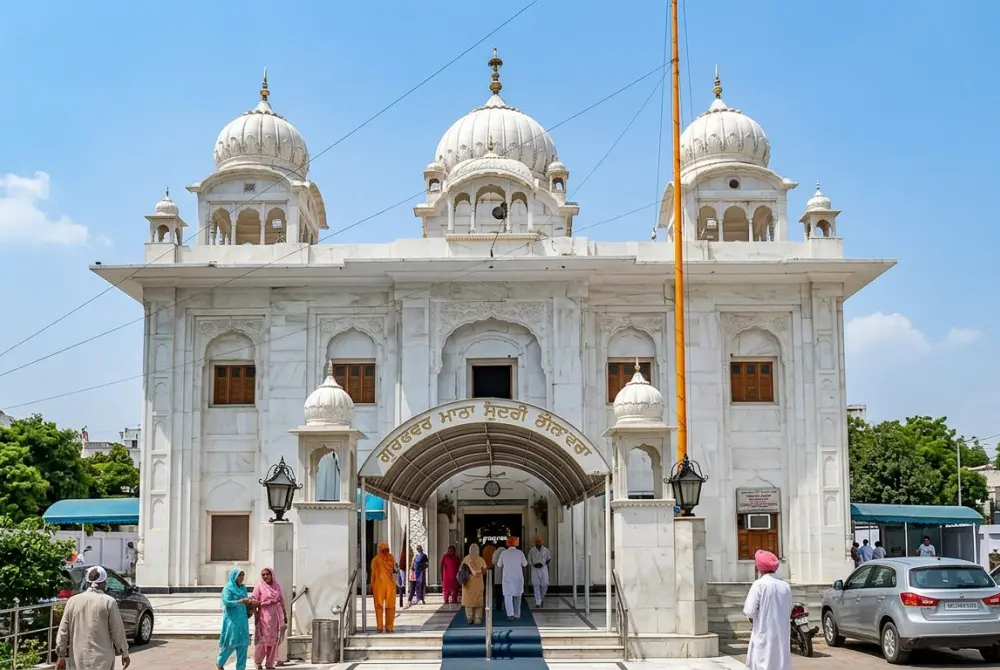
Mata Sundri Ji was one of the consorts of Guru Gobind Singh, the tenth Sikh Guru, and a figure of considerable strength and resolve. After the Guru’s death in 1708, she became a guiding force for the Sikh community during an extraordinarily difficult period of Mughal persecution. This Gurudwara, located near the cultural heart of Delhi in the Mandi House area, honors her legacy.
The shrine sits close to some of Delhi’s most important cultural institutions, including the National School of Drama and the Kamani Auditorium. That neighborhood context makes for an interesting day: a quiet morning at the Gurudwara followed by an afternoon in Delhi’s arts district.
Gurudwara Mata Sundri is quieter than Bangla Sahib and Sis Ganj Sahib, which works in its favor. The atmosphere feels more intimate. If you want to spend time sitting in the prayer hall listening to kirtan without navigating large crowds, this is the right place.
The Gurudwara is also significant for how it acknowledges women in positions of spiritual and administrative leadership within the Sikh faith, a dimension of Sikh history that tends to get overlooked in most travel writing about India.
5. Gurudwara Bala Sahib – A Peaceful Sikh Shrine Near the Yamuna River
- Location: Hari Nagar Ashram, East Delhi
- Best Time to Visit: October to March
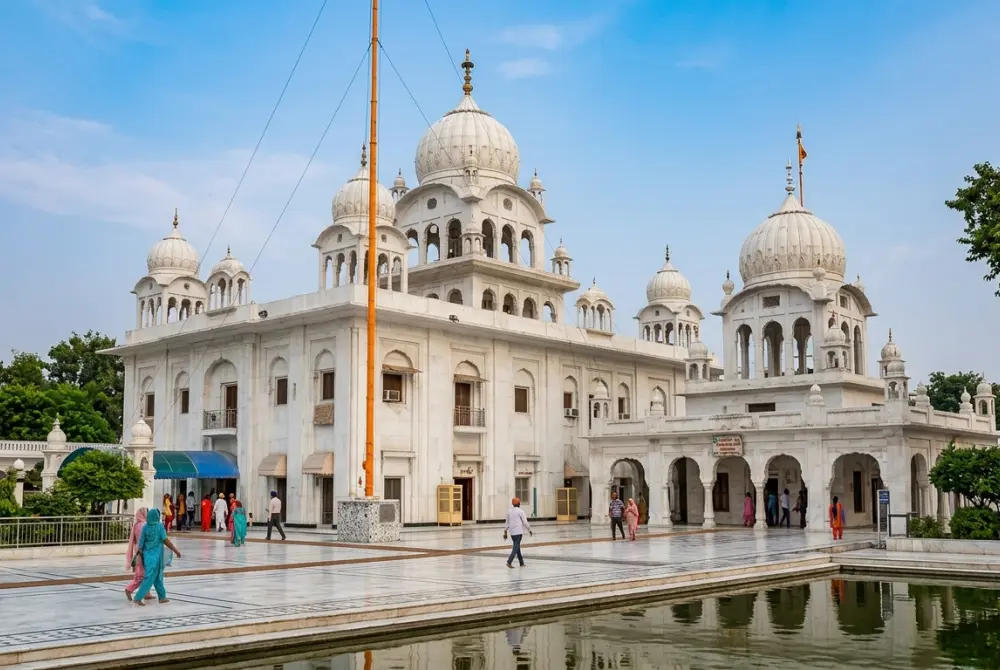
Gurudwara Bala Sahib sits close to the banks of the Yamuna River in east Delhi and is tied to one of the more poignant stories in Sikh history. Guru Har Krishan, the same eighth Guru associated with Bangla Sahib, passed away here in 1664 at just eight years of age. He had contracted smallpox while tending to the sick, placing the welfare of others ahead of his own right up to the end.
The Gurudwara’s location near the river gives it a calming quality that the more centrally located shrines don’t share. The grounds are spacious, the sarovar is well maintained, and the general pace of the place feels unhurried in a way that is genuinely good for the spirit.
This is one of the Sikh pilgrimage sites in Delhi that draws large numbers of devoted Sikhs but relatively few foreign tourists, which means your experience here will be more personal. Locals are generally happy to share the history of the site if you express genuine curiosity.
Dress modestly, cover your head (scarves are available at the entrance), and plan to spend at least 45 minutes here. It is not a place you want to rush.
6. Gurudwara Moti Bagh Sahib – A Serene Sikh Temple in South Delhi
- Location: Moti Bagh, South Delhi
- Best Time to Visit: October to March
Gurudwara Moti Bagh Sahib is associated with Guru Gobind Singh, who is said to have camped in this area during his time in Delhi. The Gurudwara was established to commemorate his presence here, and it remains an active center of daily worship and community service.
The prayer hall is large and well organized. Evening kirtan sessions draw a devoted congregation, and the atmosphere during those sessions, with voices filling a marble hall and soft lamplight overhead, is genuinely moving. You don’t need to understand the words to feel the sincerity in the room.
Moti Bagh is a residential neighborhood in south Delhi, and this Gurudwara blends into the daily life of the community around it in a way that larger, more prominent shrines don’t always manage. You are more likely to see families stopping in after work, elderly residents completing their morning rounds, and children running through the courtyard than tour groups with selfie sticks.
For travelers staying in south Delhi or passing through on their way to other neighborhoods, this is a worthwhile stop that requires almost no detour.
7. Gurudwara Damdama Sahib – Where Guru Gobind Singh Met Bahadur Shah
- Location: Nizamuddin East, Central-South Delhi
- Best Time to Visit: October to April
History intersects geography in interesting ways at Gurudwara Damdama Sahib. This is the site where Guru Gobind Singh, the tenth Sikh Guru, met Bahadur Shah in 1707, a meeting that carried significant political weight during a period of shifting alliances between the Sikh community and the Mughal court.
The Gurudwara was built by Sardar Baghel Singh in 1783 and later renovated by Maharaja Ranjit Singh. Both names are central to Sikh political history, and the layering of their contributions to a single site makes Damdama Sahib particularly interesting for anyone who wants more than a surface-level encounter with Sikh heritage in Delhi.
Inside, there is a library and a small museum with paintings and artifacts related to Sikh history. For American travelers who want real context on who the Sikh Gurus were and what they stood for, spending an hour in this museum before moving on to the other Gurudwaras makes everything else you see in the city click into place.
The Holla Mohalla festival celebrated here each year, shortly after Holi, features mock battles, martial arts demonstrations, and live music. If your travel dates align, this is one of the more spectacular things you can witness in Delhi.
8. Gurudwara Rakab Ganj Sahib – Built Where Guru Tegh Bahadur’s Body Was Cremated
- Location: Pandit Pant Marg, Near Parliament House, New Delhi
- Best Time to Visit: October to March
Gurudwara Sis Ganj Sahib marks where Guru Tegh Bahadur was executed. Gurudwara Rakab Ganj Sahib marks where his body was cremated. Together, the two shrines form a kind of sacred geography of his martyrdom spread across the city.
After the execution in Chandni Chowk, a devoted Sikh named Lakhi Shah Vanjara secretly brought the Guru’s body to his home in what is now this neighborhood. To give the Guru a dignified cremation without being detected by Mughal authorities, Lakhi Shah burned his own house down. That act of sacrifice is what Rakab Ganj Sahib commemorates, and it is one of the more stirring stories connected to any Gurudwara in Delhi.
The Gurudwara is built in white marble and sits remarkably close to the Indian Parliament building. It is one of the few historical Gurudwaras in Delhi where you can look out from the compound and see the machinery of modern Indian democracy right next door, which creates an unexpected and thought-provoking visual contrast.
The location makes it easy to combine with a visit to Bangla Sahib and Jantar Mantar in a single morning, since all three are within comfortable walking distance of each other near Connaught Place.
9. Gurudwara Majnu Ka Tilla – A Lesser-Known Gem on the Yamuna Banks
- Location: Outer Ring Road, Near Chandni Chowk, North Delhi
- Best Time to Visit: September to February
Majnu Ka Tilla has a layered identity that makes it unlike any other Gurudwara on this list. The site is connected to Guru Nanak Dev Ji, the founder of Sikhism, who is said to have rested here during his travels and met a local ascetic known as Majnu, a man so consumed by devotion that he had withdrawn entirely from the world. The Guru is believed to have brought him back to a place of earthly purpose through conversation and kindness.
That historical root sits inside a neighborhood that has, over the decades, become home to a large Tibetan refugee community. The streets around the Gurudwara are lined with Tibetan restaurants, shops selling thangka paintings, and small Buddhist shrines. The combination is unlike anything else in Delhi, and it creates a genuinely unusual afternoon if you give the area the time it deserves.
The Gurudwara itself sits right on the Yamuna riverfront and has a peaceful, unhurried quality. For American visitors, the surrounding neighborhood offers a window into Himalayan culture that is well worth half a day on its own.
This is not a well-known stop on the standard tourist trail, which is, honestly, a strong argument for going.
10. Gurudwara Nanak Piao Sahib – Where Guru Nanak Dev Ji Served Water to Travelers
- Location: Rana Pratap Bagh, North Delhi
- Best Time to Visit: October to March
The name says it all. “Nanak Piao” translates loosely to “Nanak gives water,” and this Gurudwara commemorates the time when Guru Nanak Dev Ji camped in this area during a visit to Delhi and spent his days offering free water and food to passing travelers. That simple act of service is one of the foundational gestures of Sikhism, and this site keeps its memory alive.
Gurudwara Nanak Piao Sahib is one of the oldest Sikh sites in Delhi, predating many of the other Gurudwaras on this list. It is quieter, less crowded, and sits in a residential pocket of north Delhi that most tourists never reach.
If you are the kind of traveler who prefers places that haven’t been absorbed into the tourism circuit, this is exactly where you should go. The devotees you will meet here are almost entirely locals. The langar is simple and honest. The atmosphere is still, in the best possible sense of the word.
It pairs well with a visit to Majnu Ka Tilla, which is in the same general part of north Delhi. Together, the two make for a full morning of exploration well away from the usual tourist routes.
Gurudwara Etiquette for First-Time Visitors
You do not need to be Sikh to visit any of these Gurudwaras. Every one of them welcomes visitors of every faith, and the welcome is genuine. That said, there are a few guidelines worth following before you step inside.
- Cover your head: This is required at all Gurudwaras without exception. You do not need to bring anything special. Each Gurudwara provides scarves or bandanas at the entrance, usually at no cost. Tie it securely before you enter the main compound.
- Remove your shoes: Shoes are left at the entrance in designated areas. Socks are perfectly fine to wear inside. Most Gurudwaras have staffed shoe counters where your footwear is looked after while you are inside.
- Wash your hands and feet: Most Gurudwaras have a water tap or a shallow foot bath near the entrance. Use it before entering the prayer hall, and especially before sitting down for langar.
- Dress modestly: There is no strict dress code beyond covering your head, but shorts and sleeveless tops feel out of place. Light cotton clothing that covers your arms and knees is appropriate and practical in Delhi’s climate.
- Photography: Policies vary by Gurudwara. Many allow photography in the outer courtyards but not inside the prayer hall during active worship. When in doubt, ask someone at the entrance. When a devotee looks uncomfortable, put the camera away.
- Langar: The communal meal is open to everyone. Sit on the floor in rows alongside other visitors, accept what is served with both hands, and do not waste food. The entire operation runs on volunteer labor and communal respect. Eat what you take.
- Alcohol and tobacco: Do not bring either onto the premises.
Why Choose Indian Travel Package as Your Travel Partner for a Better Gurudwara Experience
Visiting Delhi’s famous Gurudwaras on your own is absolutely doable. But if you have traveled internationally before, you already know how much a single wrong turn, a missed timing, or a gap in cultural context can cost you in a city as layered and fast-moving as Delhi. That is where connecting with a tour and travel agency in Delhi changes the entire shape of a trip.
Indian Travel Package specializes in helping international travelers, particularly those coming from the US, UK, Canada, Australia, Spain, etc. can get the most out of India’s spiritual and heritage destinations. Here is what that looks like in practice when you are planning a Gurudwara visit in Delhi.
- They know the timing, and timing matters here: Gurudwara Bangla Sahib at 6 AM during morning prayers is a completely different experience from visiting at 2 PM on a Tuesday. Gurudwara Sis Ganj Sahib during the evening aarti carries an atmosphere that an afternoon drop-in simply cannot match. Indian Travel Package builds your itinerary around these windows so you are at the right place at the right time, without having to figure it out yourself from a spreadsheet and three browser tabs.
- Local guides who actually know the history: Reading about Guru Tegh Bahadur’s martyrdom in a guidebook is one thing. Hearing a knowledgeable local guide explain the political context, walk you through the architecture of the prayer hall, and answer your questions in real time is something else entirely. Indian Travel Package works with guides who understand both the religious significance of these sites and how to communicate that history to a Western audience without oversimplifying it.
- Logistics handled from the airport forward: Delhi traffic is not something you want to be problem-solving on your first morning in the country after a 14-plus hour flight. Transportation between Gurudwaras, airport pickup, hotel coordination, and day-to-day ground logistics are all managed so that your energy goes into the experience, not the planning.
- Customized itineraries, not cookie-cutter packages: Whether you want to cover all 10 Gurudwaras on this list over three days, or pair a Gurudwara circuit with visits to the Red Fort, Humayun’s Tomb, and Old Delhi’s food lanes, the team at Indian Travel Package builds around your schedule and your interests. Nothing about the itinerary is fixed until you are satisfied with it.
If you are planning a trip to Delhi and want your Gurudwara visits to feel like a genuine experience rather than a checklist, reaching out to Indian Travel Package before you book anything else is a practical first step.
Frequently Asked Questions
Which is the most famous Gurudwara in Delhi?
Gurudwara Bangla Sahib on Ashoka Road is the most famous and most visited Gurudwara in Delhi. It is open 24 hours a day, easy to reach by metro, and serves free langar around the clock to thousands of visitors every day. If you are short on time, this is the one to prioritize.
Which is the oldest Gurudwara in Delhi?
Gurudwara Sis Ganj Sahib in Chandni Chowk, established in 1783, is considered one of the oldest Gurudwaras in Delhi. It marks the martyrdom site of Guru Tegh Bahadur, the ninth Sikh Guru, and remains one of the most historically significant Sikh shrines in northern India.